
Visual intelligence for designers
Every image hides a rule.
See the source. Develop the unexpected.
Morphogen Studio reads the rules inside an image, the forces and relationships that made it, and translates them into original architecture, landscape and interiors. You generate in the image tools you already use; Morphogen keeps the design consistent and every decision traceable.
01 The problem
Image tools give you pictures. They do not give you a design.
Every prompt is a re-roll.
A hundred beautiful strangers arrive and none of them is yours. Direction accumulates in your head, never in the work.
The second view changes its mind.
Materials wander, silhouettes melt, the palette shifts. There is no identity to hold, because none was ever defined.
The source is pasted on.
A photograph of rock returns a rock-shaped building. That is imitation, not translation.
Morphogen works one layer above the image tools: read the source, extract its rules, develop a concept, then generate, with the rules checked every time an image comes back.
02 Worked example · real records
One photograph, followed through all nine moves.
The Fractured Tide Bathhouse, from the studio record. Step through it: what was seen, what was extracted, what carried, and what honestly did not.
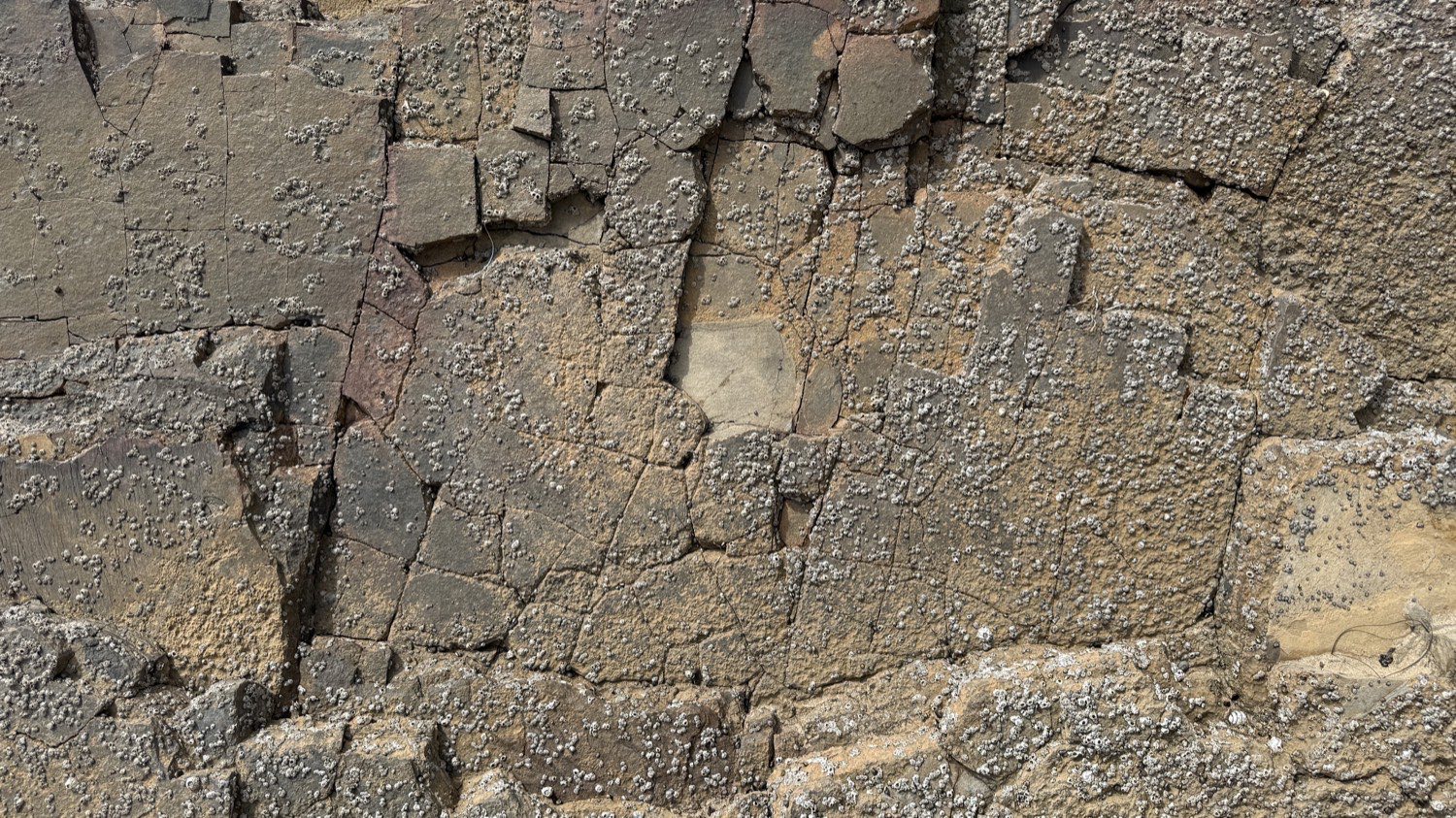
One photograph from a walk on the shore.
Coastal rock at Crystal Cove, Newport Coast, photographed by Carlos Meyer. Eight captures cover all four views the method asks for.
Photographer and permission on record.
Name the forces that made it.
Observation first: thin plates stacked and tilted to one steep dip, cut by two joint sets, a dark band of mussels at the wet base, barnacles clustered along the joints. Then inference, marked as such: the forces the image reads as.
Forces, reads as
- thin-bed deposition
- tectonic tilting
- stress jointing in two sets
- tidal sand abrasion
- differential erosion
- colonization by exposure
- iron oxidation
Seven forces, each supported by what is visible. None added to fill a quota.
Ten rules, four of them primary.
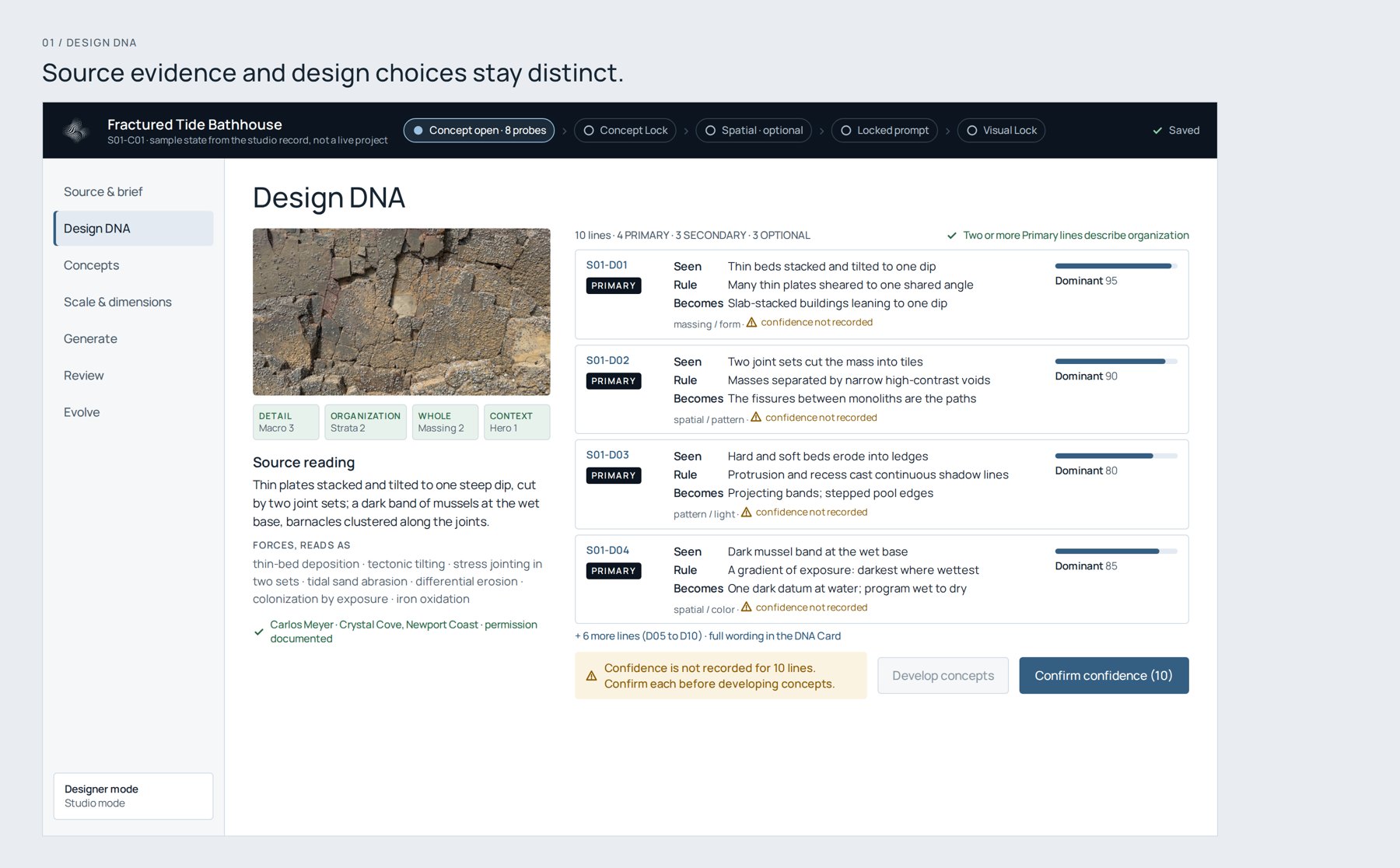
The reading becomes Design DNA: five to ten rules, each with what was seen, the rule behind it, and what it can become. At least two primary rules must describe organization, not surface. Here all four do.
You can edit, reweight or remove any line. The DNA is yours to direct.
- Seen
- Thin beds stacked and tilted to one dip
- Rule
- Many thin plates sheared to one shared angle
- Becomes
- Slab-stacked buildings leaning to one dip
- Seen
- Two joint sets cut the mass into tiles
- Rule
- Masses separated by narrow high-contrast voids
- Becomes
- The fissures between monoliths are the paths
- Seen
- Hard and soft beds erode into ledges
- Rule
- Protrusion and recess cast continuous shadow lines
- Becomes
- Projecting bands; stepped pool edges
- Seen
- Dark mussel band at the wet base
- Rule
- A gradient of exposure: darkest where wettest
- Becomes
- One dark datum at water; program wet to dry
Say what it becomes.
The brief turns the rules toward a program. Three dials are declared on every job.
- Brief
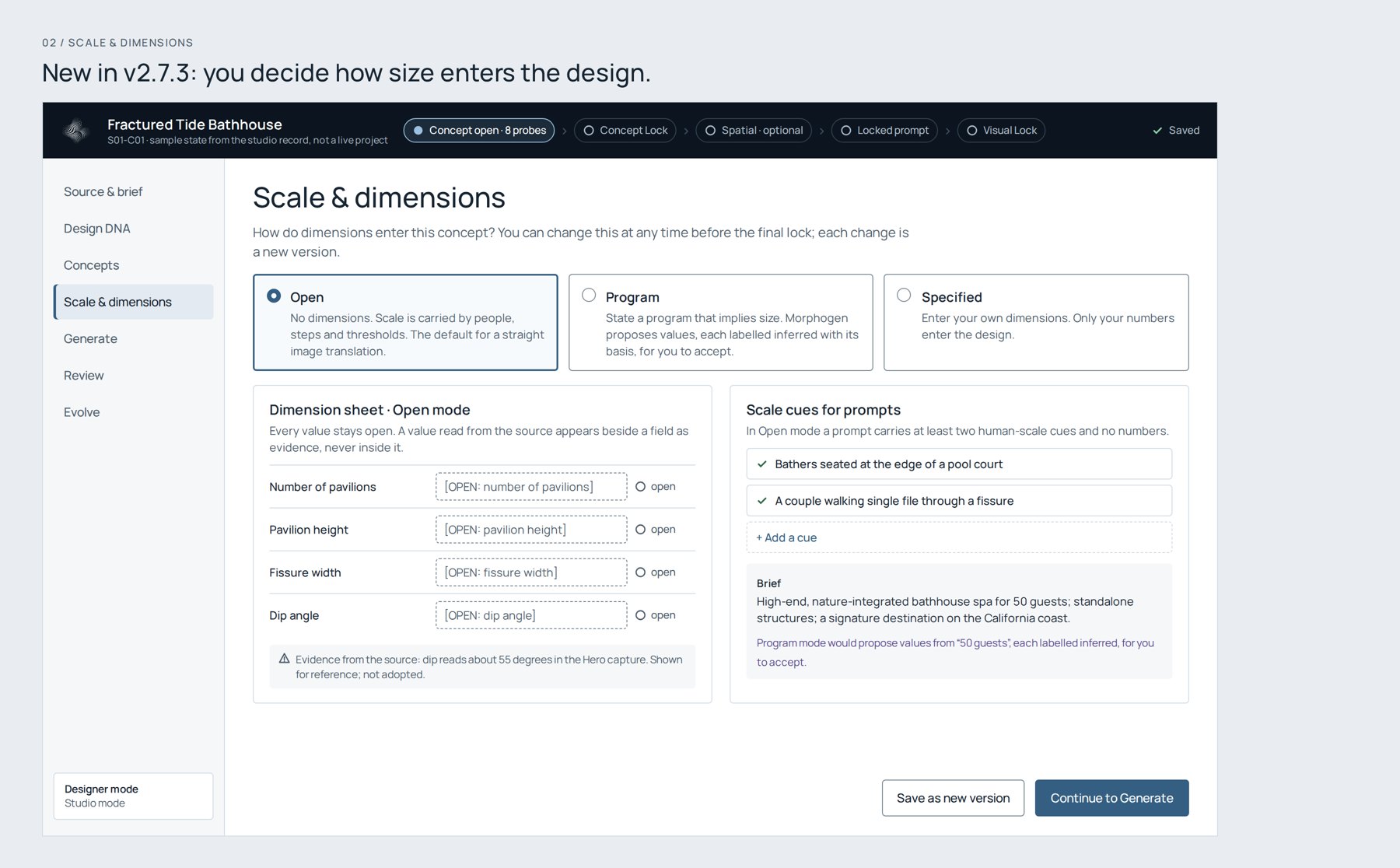
- A high-end bathhouse spa for 50 guests, standalone structures, a signature destination on the California coast.
- Translation distance
- D2 Abstract: the logic stays legible, the rock itself is absent.
- Scale control
- Open. No dimensions were given; people, steps and thresholds carry the scale.
- Scale jump
- Classified by what survives, not by an invented ratio: the joint network survives as organization; the barnacle texture does not survive at all.
One rule carries clearly: fracture became circulation.
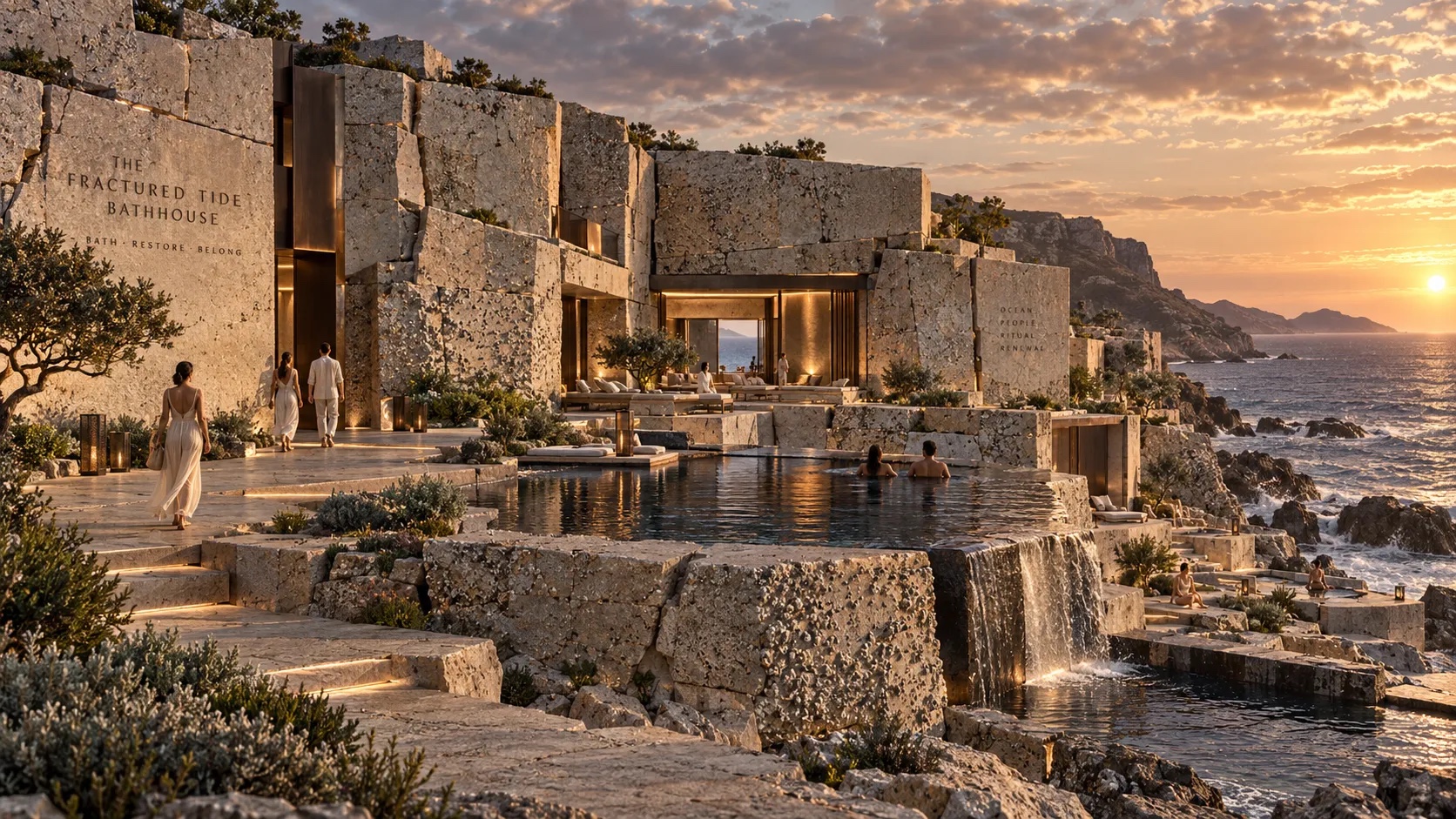
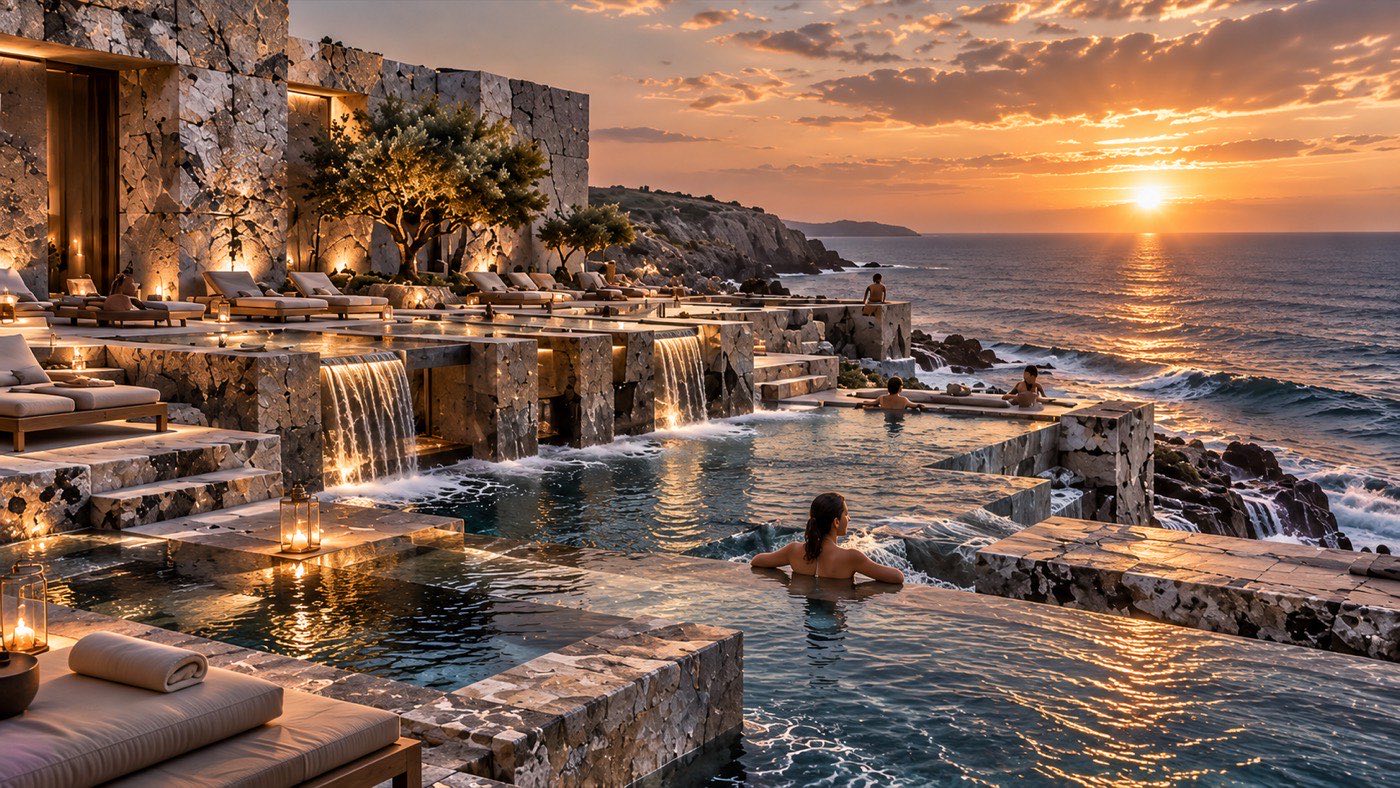
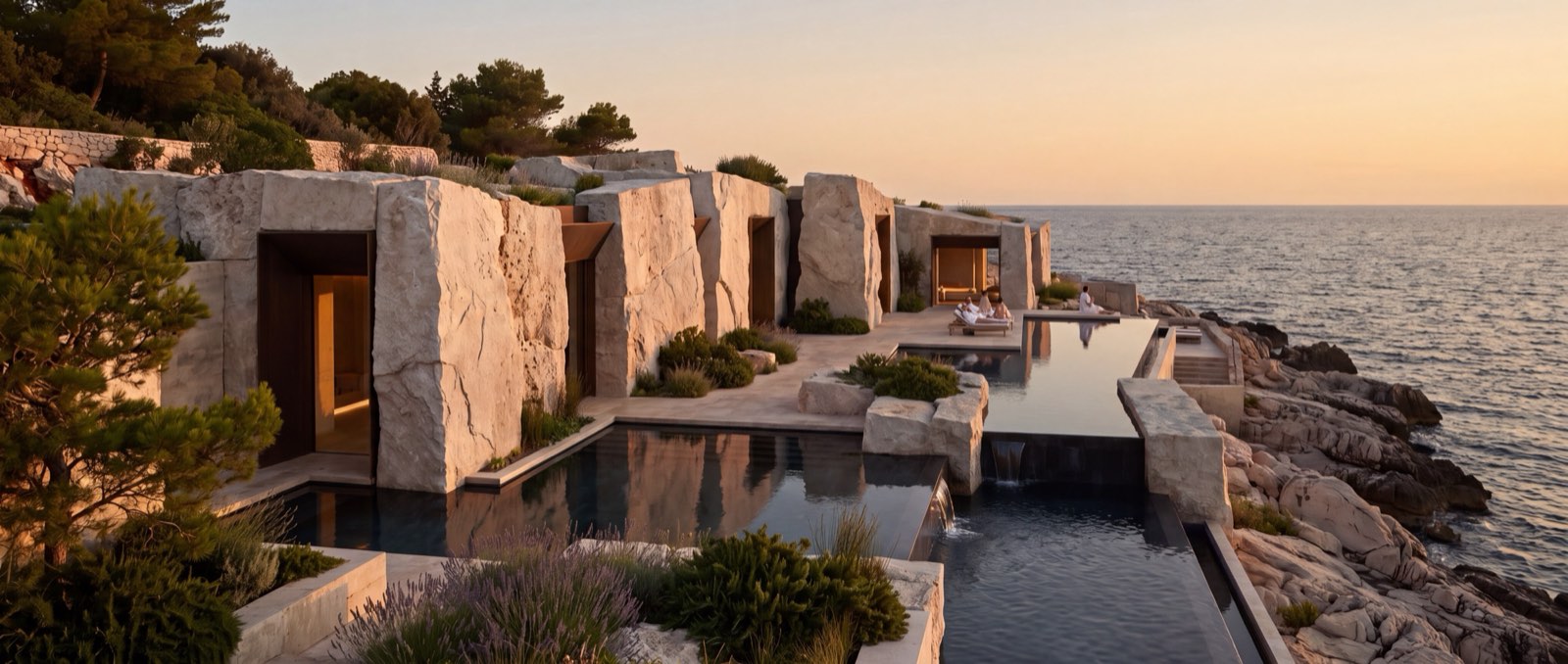
Separate stone masses are divided by narrow fissures, and the fissures are the way in. Pools step down the terrace toward the sea.
Released at this stage: the rock’s lean (D01) and its dark tide line (D04). The barnacle texture does not survive the change of scale; its rule, intensity along the joints, survives as light along the paths.
- The fissure rule holds from the arrival passage to the pool court.
- Circulation runs in the gaps between stone masses, never around a single object.
- A pale stone palette throughout; warmth arrives only as light, lanterns and sky.
One master prompt, then an adapter per tool.
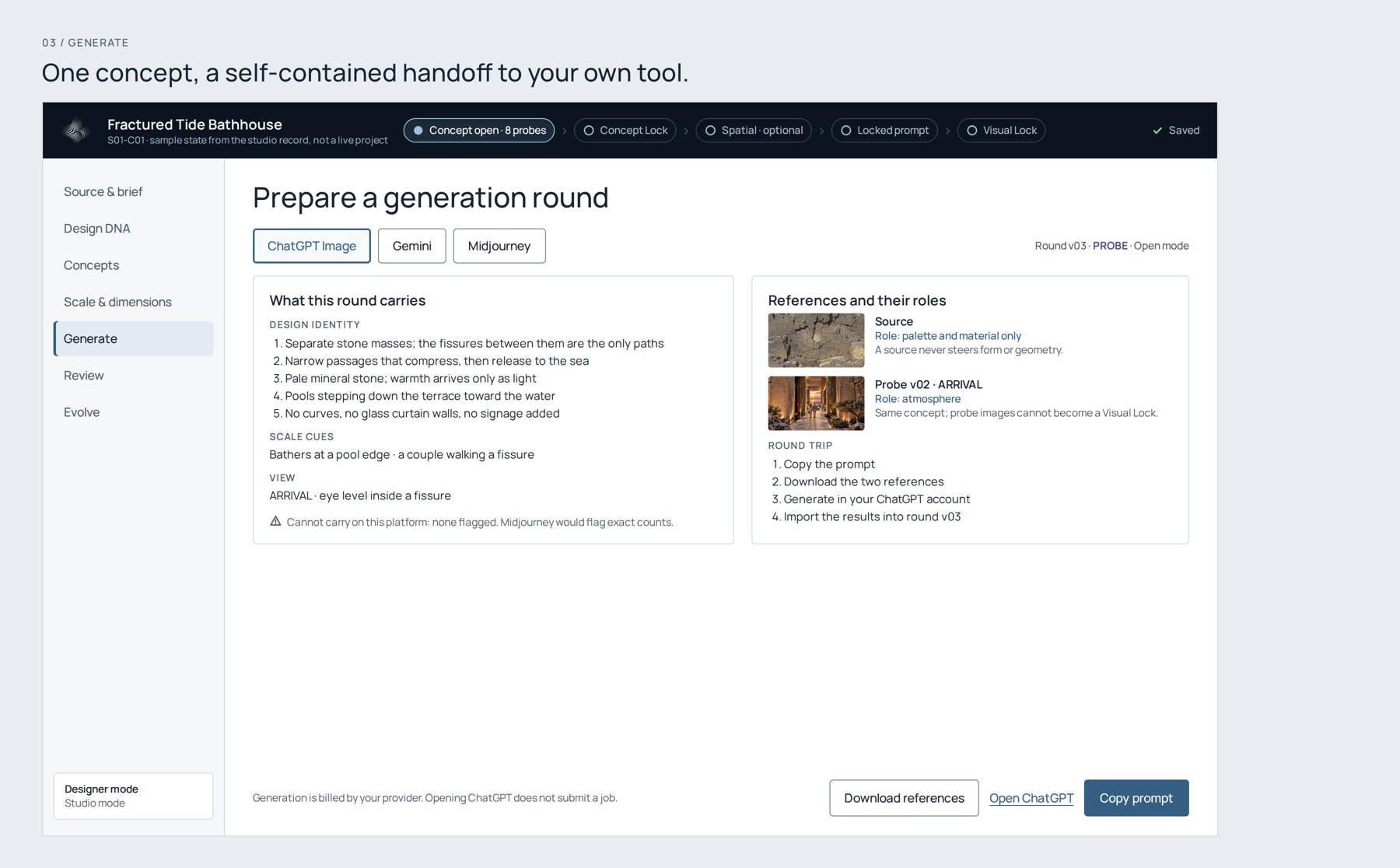
In the method, the concept compiles into a single twenty-slot master prompt: design first, rendering last. Each image tool gets an adapter that may change syntax, never the design.
Generated in the designer’s own tools.
ChatGPT Image, 6 September 2026, and a second image in Gemini. Images unaltered, lettering included.
HERO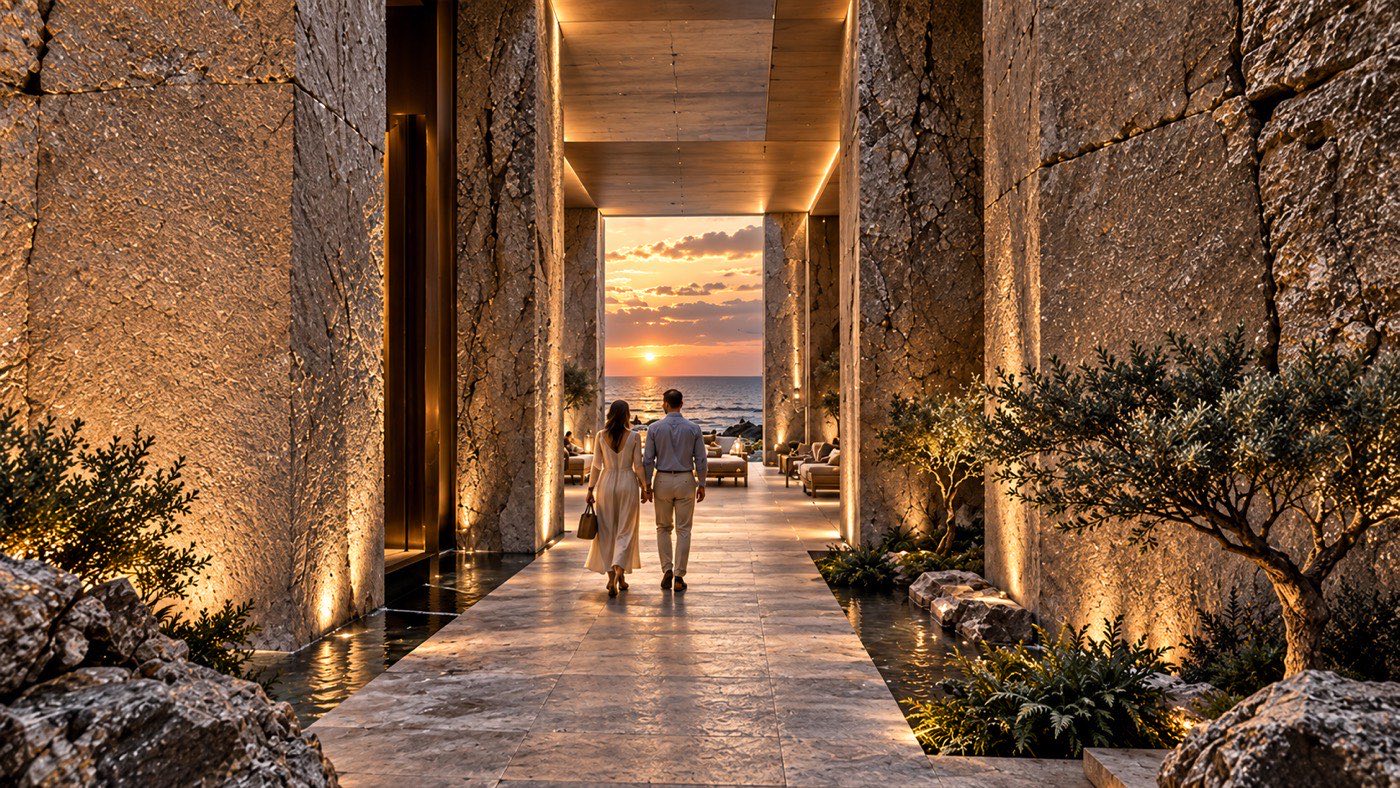 ARRIVAL
 HUMAN
 CONTEXT
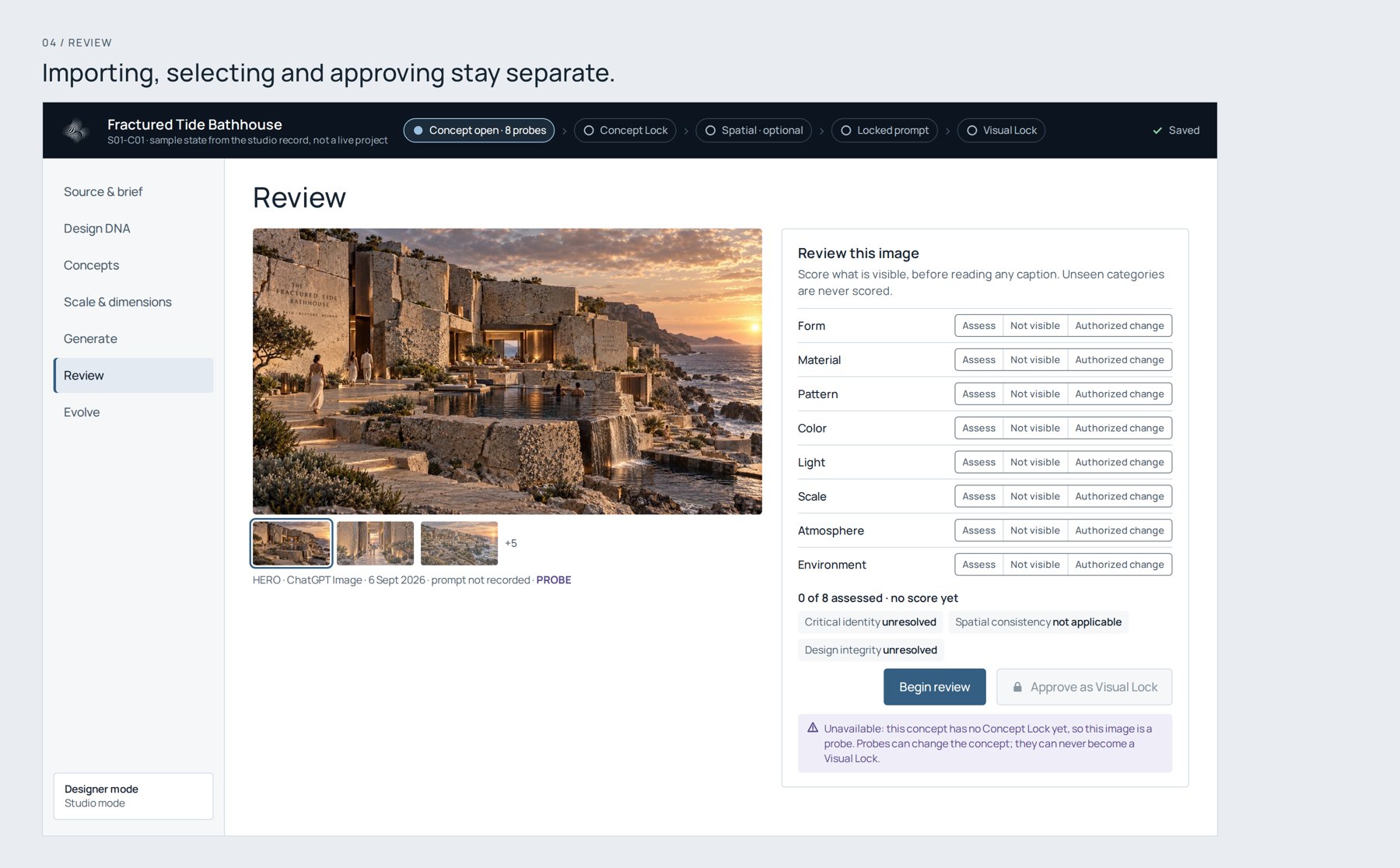
No lock yet, on purpose.
These images were made before any Concept Lock, so they are probes. A probe can change the concept. It can never become a Visual Lock.
Locks are decisions the designer makes. Nothing is frozen silently.
Carry it forward without losing it.
The next version could bring back what was released, the lean and the tide line, as a new concept version. The original images stay exactly as they are; nothing is overwritten, and every version keeps its parent.
The rule, traced from rock to room.
One rule travels the whole way: continuous masses separated by narrow fissures. In the rock it is a crack. In the building it is the way in.
Crystal Cove, Newport Coast. Principal joints traced by hand from the photograph; two joint sets divide the stone into separate plates.
The same joints, straightened and extended until they meet, as joints end against one another in rock. Every tile becomes a mass; every joint becomes a narrow path. A statement of the rule, not a plan of the building.
Two stone masses, a narrow passage between them, release to the horizon. Fractured Tide Bathhouse, ChatGPT Image, generated with no dimensions given.
Three different claims, kept separate: what the photograph shows (01), the rule Morphogen extracted from it (02), and where that rule is visible in the generated image (03). The building was generated without a recorded plan, so the diagram states the rule, not the building's geometry.
Read the source. Develop the design. Carry it forward.
Every project moves through the same nine steps. You see three of them at a time; Morphogen keeps the rest recorded behind you.
Bring an image. Morphogen reads what is visible, names the forces that made it, and turns them into Design DNA you can edit.
Say what it becomes and how much you know about its size. Compare three directions, develop one, and lock it when you are ready.
Generate in your own image tool. Bring the results back, judge them against the rules, lock what holds, and evolve without losing identity.
Generation happens in ChatGPT Image, Gemini or Midjourney under your own account. Morphogen prepares the prompt, keeps the rules, and records what comes back.
Nothing is frozen until you say so.
A concept stays open while you explore it. Each lock is a decision you make, and each one protects a different part of the design.
Concept, open
You canadjust, test with images, edit, fork or swap. Every change is a new version.
Scaleopen, from your program, or your own dimensions.
Concept Lock
Freezesthe thesis, the primary DNA and the design rules.
Needsyour approval. No image is required.
Spatial Lock
Freezesthe layout: elements, counts and relationships.
Needsset dimensions, and only when two views must show one arrangement.
Locked prompt
Carriesthe locked design into one master prompt and an adapter for each tool.
Neverchanges the design to suit a platform.
Visual Lock
Freezeshow it looks: material, pattern, palette, light, within the locks above.
Needsan approved image, reviewed against the rules.
03 Three dials
Declared on every job, before any image is made.
How far from the source.
D1 Literal keeps the source recognizable. D2 Abstract keeps the logic and loses the object. D3 Remote keeps only the deep organization, for worlds and planets.
What each rule survives as.
A crack a few centimetres long cannot become a wall texture at building scale. It survives as pattern, as rhythm, or only as organization. The method says which, rule by rule.
How dimensions enter.
Every number shows where it came from. Morphogen never presents an invented number as yours, or as a fact about the source.
04 The app · private trial
The method becomes the interface.
The nine-move method is grouped into workspaces, with the lock track across the top and one primary action per screen. Shown here with the bathhouse record in a sample state. These are interface studies: the app now in private trial covers the first steps, from source to master prompt.
Feedback
Seeing this early? Tell us what landed.
Five short questions. What was clear, what was not, and whether you would use it.
07 Direct answers
Questions designers ask first.
Is Morphogen an image generator?
No. It works above the generators: analysis, translation, the master prompt, review and locks. Images come from the tool you already use, under your own account.
Which image tools does it work with?
The adapters in use today are ChatGPT Image, Gemini and Midjourney. The design does not depend on any one tool.
Does it copy the source?
No. It translates the rule behind the source, not its appearance, unless you ask for a literal study. It does not imitate known buildings or architects.
Who owns the work?
You do. Your sources stay yours, and the project record is yours to keep. Images follow the terms of the tool that made them.
Are these buildings ready to build?
No. Every image is a concept visualization. Morphogen labels constructability as proven, plausible or speculative, and never claims more than was checked.
When can I use it?
Now, by invitation. Request a place: two sessions are free. The Method Pack follows for the founding cohort, so you can also run the method inside the AI workspace you already use.